The journey…
…started with the purchase of a mono record. Some years ago, I saw that a local bookseller was offering up his LP collection for sale in his shop and I bought a few. I had an older turntable, a Project Debut, and it was fun spinning these old discs. And there was some really good music including one recording that really stood out, a Deutsche Grammophon Archiv Produktion recording of Bach’s Brandenburg Concerti.
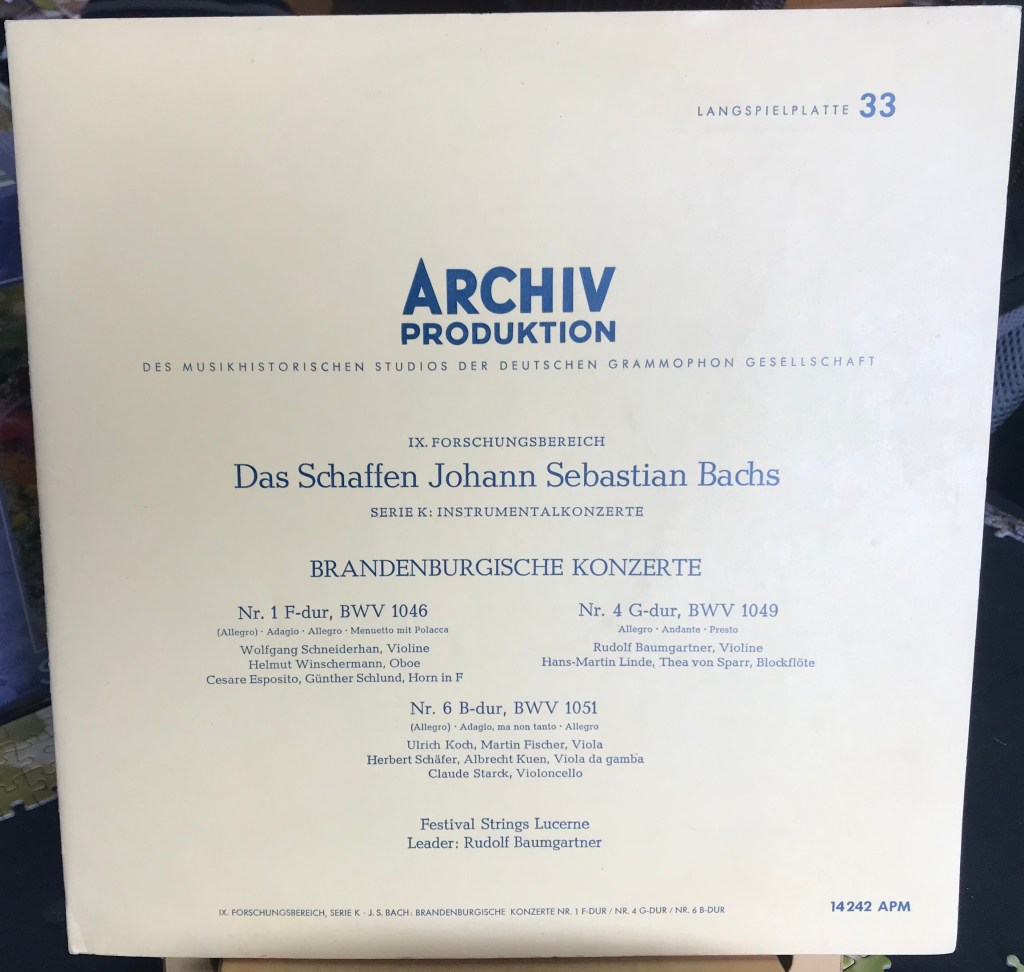
The turntable/phono-stage wasn’t the best, with a lot of hum and noise, and I only had the few records so I kind of lost interest for a while. But something about the beauty of that Bach performance stayed with me. The record was one of a set of two and I got the idea to see if I could find the other. This led me to Discogs and a whole treasure trove now lay before me. I found that second Bach and other Archiv Produktion recordings.
Listening to many of those old performances was a delight and I discovered some real gems. (I’ll share one here in a bit.) Now I wanted a new turntable. Technics had just introduced their SL-1500C turntable and that seemed to tick all the boxes. It came with the Ortofon 2M Red cartridge and the improvement was amazing.
But there was still something about playing mono records on a stereo system that was not quite right. The sound should have been centered but seemed to drift around. I attributed this to possible phase differences in the channels. Maybe? Looking at the waveforms on an oscilloscope didn’t show anything glaringly different in the two channels. Maybe it was just room acoustics. Whatever, that dancing around of the sound source was annoying. Listening to a single channel on a single speaker was fine but didn’t sit well with me as the solution.
So, the beginning of a dedicated mono system. I decided that the system should reflect what would have been possible at the time, the late 1950s, early 60s. That meant a tube-based system and a contemporary speaker design.
The system
I first built the power amplifier. There are seemingly endless circuit designs out there for tube amps. I finally decided on the reference design for an amplifier based on the EL34 power pentodes from Mullard, the Mullard 4-30. A lot of help came from an article by Claus Byrith that you can find here: https://www.lundahltransformers.com/old-fasioned-30w-push-pull-amplifier/. I’ll give more details in a future post.
I used this together with the turntable’s built-in phono-preamp and really liked the results. There was one issue however. Many of the early German recordings used a different equalization from RIAA called DIN. So, I built a small correction circuit to bring playback in line with this equalization.
Next came the cartridge. There are actually a few manufacturers of mono cartridges. I really wanted to stay with a moving magnet type output level. I have the Audio-Technica AT-MONO3LP, the Ortofon 2M Mono SE, (they also have the 2M Mono), and the Miyajima Spirit MONO high. If you go down this road, I’d recommend the AT-MONO3LP. The least expensive and very nice sound.
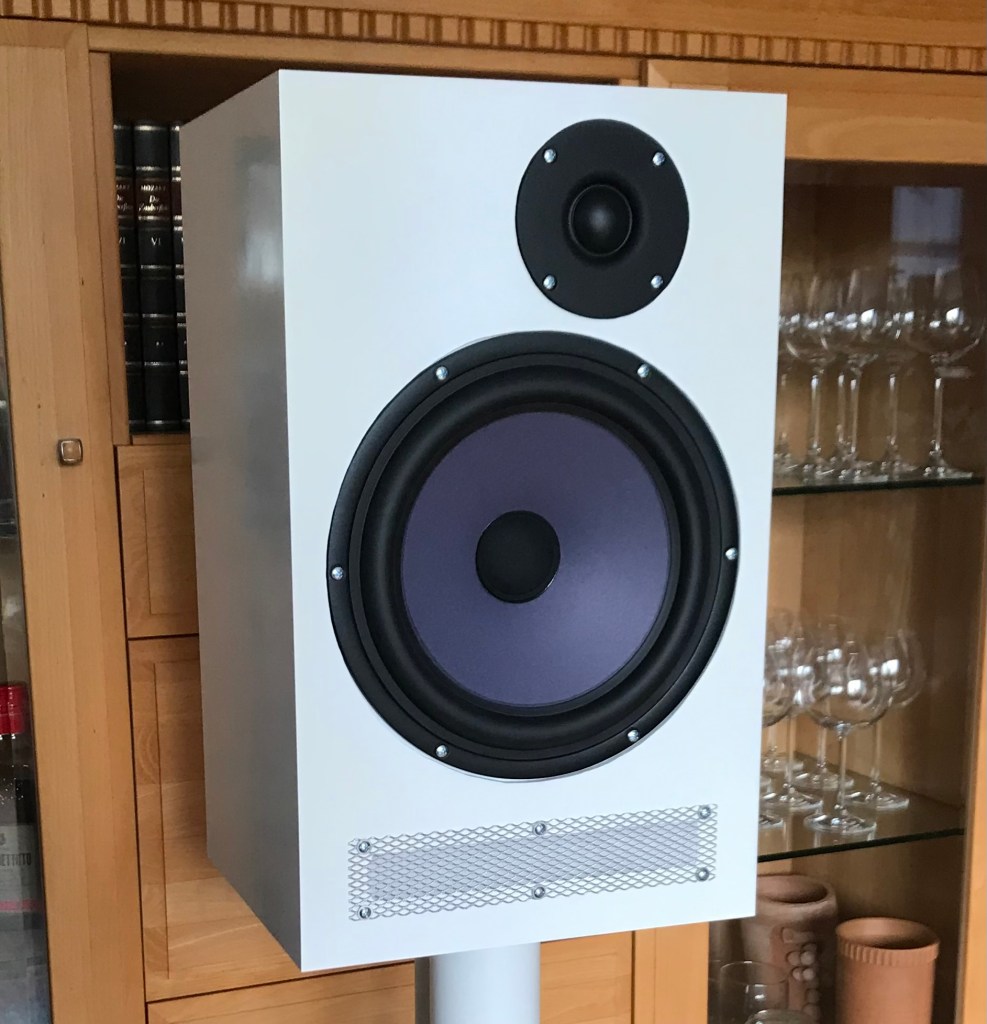
Now I needed a speaker. A friend suggested I look into the Seas A26. This is a set of drivers, woofer and tweeter, to reproduce the classic Dynaco A25 introduced in 1969. The time period is a little late but the design seemed reasonable and within the spirit of the project. I ordered the speakers and had the local lumber yard cut some appropriate MDF pieces which I assembled according to the plans on the Seas site. I am not a woodworker and the result was, well, okay-ish. But it worked and it sounded really good.
Okay, I had the start of a really promising mono system. It was a joy listening. And there is a real depth to mono. In some ways I prefer the sound over stereo. Especially stereo with poorly presented imaging. The people with mono systems—high-end ones, anyway—had it pretty good! But there was one last piece to complete the project.
The preamp would become the most involved build of the project. It had to be tube of course and it had to provide the two equalizations I need, RIAA and DIN. I searched the web for appropriate designs and none of them really felt right. I ended up taking a lot of inspiration from the classic Morgan Jones book Valve Amplifiers (not an ad). This was invaluable and I recommend you get the physical book if you are also considering building a tube amp or preamp. The design is ultimately, though loosely, based on the development of a split-stage phono preamp in that book. The amplifier itself is all tubes. However, the power supply is a modern design using regulation for both the high-voltage and DC heater voltages. It has a cool Nixie volume level display and (this is/was 2023) some simple remote control. I am especially proud of this build. I’ll also talk about it in more detail in a later post.
Again, what a joy to hear mono presented as it should be. And that presentation is very good, indeed. Not only was it fun and challenging to assemble this system, but the result was rewarding beyond my expectations.
But one last thing remained. That white elephant in the room, the A26 speaker. Though it sounded very good, it was not a looker. I’ll let you see for yourself.
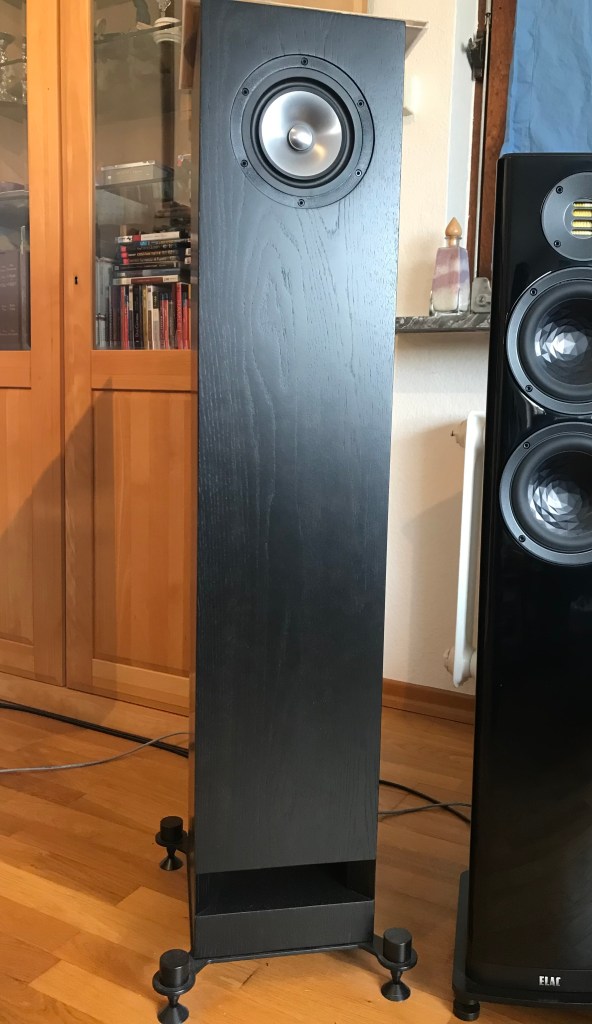
At some point, I had run across a speaker by Pearl Acoustics, their Sibelius. It has a single-driver in (I think) a folded horn cabinet. That concept had been around since the 1930s and it seemed a good fit. Since they make the speakers to-order, I contacted them and asked if they would consider building a single speaker for a mono system. It was a gamble on my part as there would be virtually no chance to sell a single unit should it be somehow unsatisfactory. For their part, they were enthusiastic and delivered a beautiful speaker that sounds extraordinary. I am very impressed by it.
(Those A26 drivers went to the friend who originally recommended them. He has purchased a second set and a pair of A26s is now in his project queue. He is a woodworker and will certainly do them justice. It really is a nice speaker.)
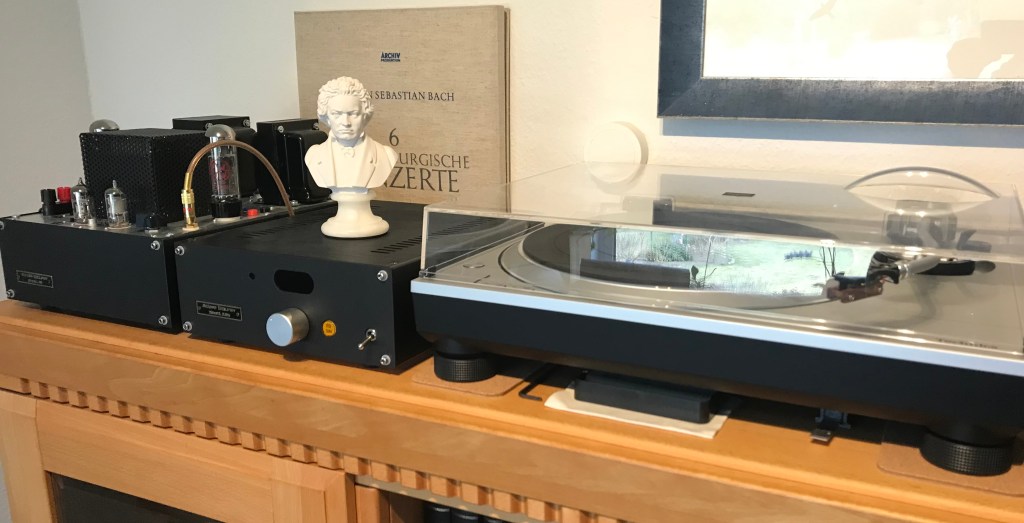
So, over three years later and many more since I had first heard that Bach concerto, I had a true HiFi mono system. And a look back to how an audiophile may have listened to music well over sixty years ago. As I said earlier, they had it pretty good.
Oh, that musical gem I mentioned.
This is a recording of Georg Friedrich Händel’s Suite No. 5 in E major for harpsichord, Archiv Produktion 13023a released in November 1954.
The suite is in four movements
1. Prélude
2. Allemande @1:44
3. Courante @6:21
4. Air mit Variationen (The harmonious blacksmith) @9:02
It was recorded on 25/26 March 1954 at the Herkules Salle der Residenz in Munich. The audio engineer was Afred Steinke. Karl Richter played the harpsichord, a Neupert-Cembalo model Vivaldi, Nürnberg 1953.
Enjoy!

This is a 44.1kHz, 16-bit WAV file. It was captured using a Technics SL-1500C turntable with an Audio-Technica AT-MONO3LP cartridge. The phono preamp is an Audio Belfry model 2EQ (yeah, that’s what I named it) with the proper DIN playback equalization. The audio interface is a Focusrite Scarlett 2i2 and the DAW is Audacity 3.7.3 running on a MacBook Pro 16, 2023. 16 March 2025, Germany.
Bonus track
From the record that started it all, Archiv Produktion 14242 released in May 1961. This is Johann Sebastian Bach’s Brandenburg Concerto No. 6 in B-major, BWM 1051. It was recorded in Zürich at the Neumünster-Kirche on 15/17 April 1959. The recording engineers were Harald Baudis and Gerhard Henjes. It was performed by the Festival Strings Lucerne, conducted by Rudolf Baumgartner. Soloists were Ulrich Koch and Martin Fischer, viola and Claude Starck, violoncello. Capture info is the same as above
Til next time.
 The Belfry
Leave a comment